
Double Rotary vs. Positioning Sheeter: Cutting Accuracy and Speed in Technical Detail
Double Rotary vs. Positioning Sheeter: Cutting Accuracy and Speed in Technical Detail
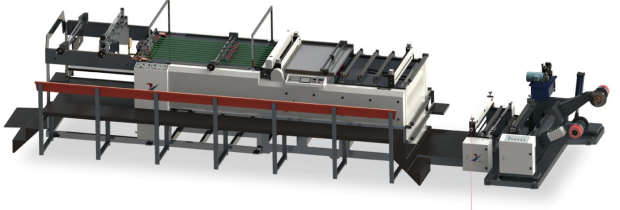
A metalized paper laminating machine sets the surface of the sheet — its gloss, barrier and bond. The cutter sets the geometry. If the cut length drifts, the register walks, or the edge is not square, the finished gold and silver cardboard will not run cleanly through printing, foiling and folding. Cutting accuracy and cutting speed therefore decide the usable output of a laminating line, not just its nominal running speed.
This technical deep dive compares the two cutting architectures used in metalized paper and gold/silver cardboard converting: the double rotary sheet cutter (YDSLX and DWLX series) and the positioning sheeter (YD series). It covers how each machine cuts, the speed and accuracy each is specified for, the role of carbon steel construction, and the packaging applications where each fits. Wenzhou Yueda Packaging Machinery Co., Ltd. (YUEDA) builds both architectures, so the comparison is grounded in machine design rather than catalogue adjectives.
Problem Definition: Where Sheet Cutting Lines Lose Accuracy
Sheet cutting is the stage where a converting line either meets specification or quietly loses money. Three failure modes dominate the shop floor, and each one has a defined control method.
- Cutting position error. When the knife fires at the wrong moment, sheet length varies from piece to piece. The control method is photoelectric correction: YUEDA fits dual photoelectric eyes (main and backup) that re-calibrate sheet position in real time, so the cut register is corrected continuously rather than after a batch is already out of tolerance.
- Tension instability. In-feed tension controls how far the web stretches before the knife closes. The control method is closed-loop servo control, with a real-time tension monitoring and adjustment system specified to 0.1 N precision.
- Machine overheating. Motors and heating rollers can drift or fail during long runs. The control method is thermal protection: temperature sensors on key components (motor, heating roller) with an automatic shutdown function.
The practical consequence is that a laminating machine running at high speed upstream is wasted if the cutter downstream cannot hold tolerance at the same rate. Speed and accuracy are a matched pair, and that pairing is exactly what separates the double rotary cutter from the positioning sheeter.
Industry Background: Why Tighter Cutting Tolerances Are Being Demanded
Metalized paper — a metallized layer bonded to a paper substrate — is a premium material, and its primary demand drivers are premium labeling and cigarette packaging. Third-party market research from DataM Intelligence values the global metallized paper market at USD 4.85 billion in 2025. Within that market, SkyQuest Technology reports that the lamination segment held a 57.4% revenue share in 2024, favored for the high gloss and barrier properties it gives consumer goods. Future Market Insights places close to 40% of global metallized paper demand in Asia-Pacific, driven by expanding tobacco and beverage industries in China and India.
The equipment side is moving in the same direction. Market Research Future recorded roughly 70% industrial laminating machine market share for wet laminating machines in 2025, reflecting their adoption in food-processing packaging. China's machinery export value rose 15.7% year on year in early 2026, with the mix shifting toward higher-value-added equipment such as servo-controlled and CNC machines, according to the German Machine Tool Builders' Association (VDW). The signal for buyers is straightforward: more metalized paper, more servo-controlled converting lines, and more pressure on the cutter to hold tolerance at speed.
For European market access, industrial laminating machines must comply with EN ISO 12100:2010 for risk assessment and safety design in order to obtain CE marking. Cutting units supplied as part of a laminating line are evaluated under the same machine-safety logic, so safety design and documentation are a procurement item rather than an afterthought.
Detailed Solution: How Double Rotary and Positioning Sheeters Cut
The two architectures solve the same problem — turning a continuous web of metalized paper into flat sheets — with different mechanics. That difference explains their speed and accuracy profiles, and it decides which one fits a given packaging job.
Double Rotary Sheet Cutter (YDSLX, DWLX Series)
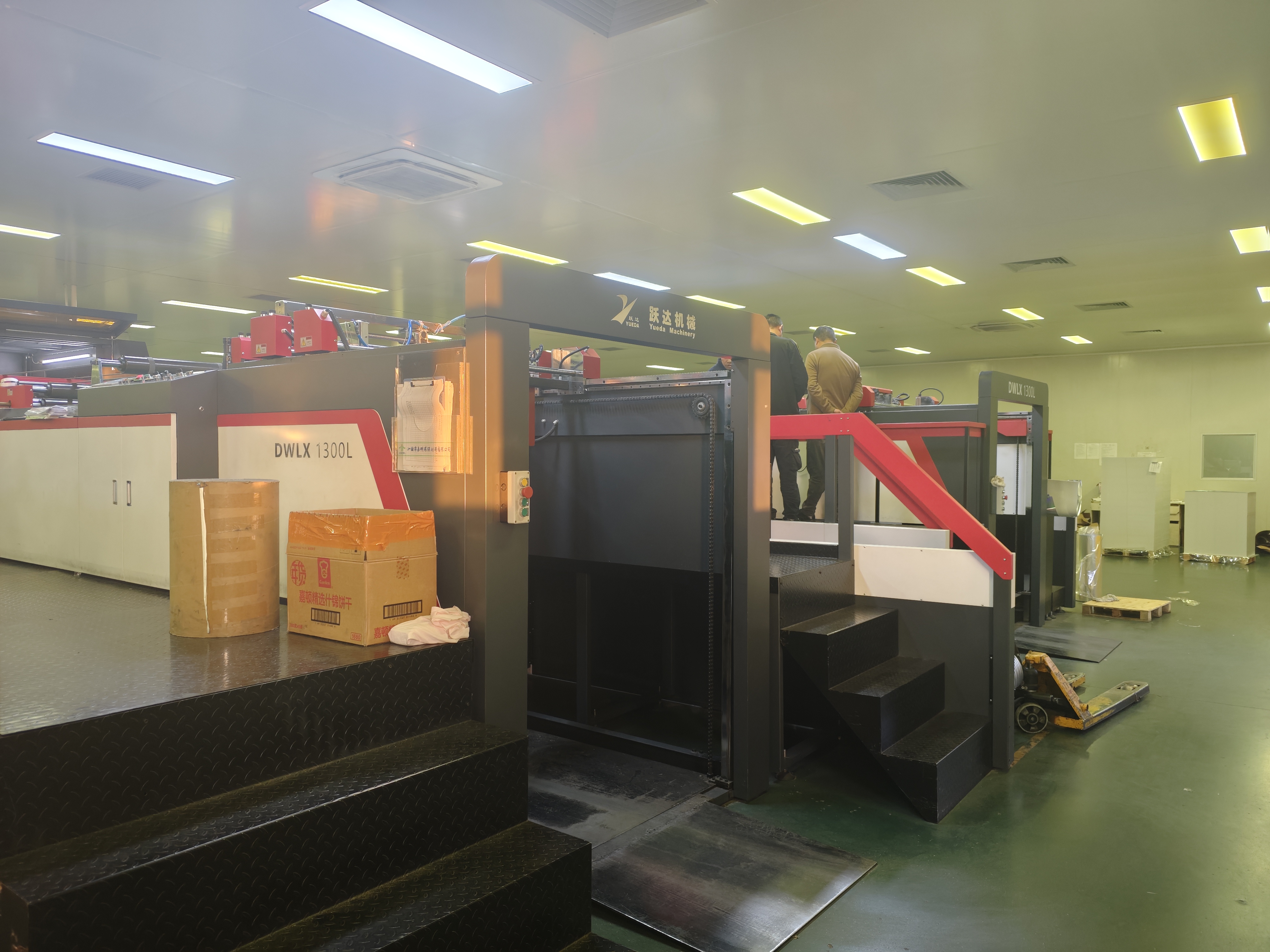
A double rotary cutter uses two rotating knife cylinders that shear the sheet as they pass. Because the knives rotate continuously, the web does not have to stop for each cut; the cutting action is a fast, repeatable shearing motion synchronized to web speed. That is what allows high sheet throughput without a stop-start cycle.
Because continuous rotary shearing depends on exact synchronization, positioning accuracy of the knife-to-web relationship is the decisive specification. YUEDA's DWLX series double rotary knife cross-cutting machine is built to ±0.1 mm positioning accuracy and is specified for cutting speeds from 10 to 400 sheets per minute, which makes it the appropriate choice when a metalized paper line must combine throughput with tight dimensional control. The frame is constructed in carbon steel, which gives the machine the rigidity a rotary shear needs; a frame that flexes under load would allow the knife gap to move and the accuracy figure would not hold.
Positioning Sheeter (YD Series)
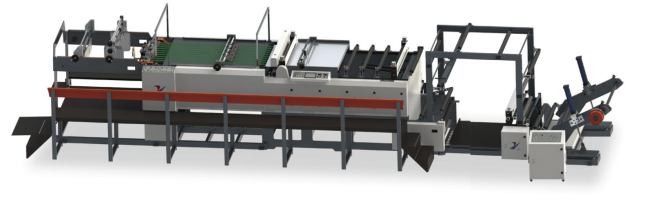
A positioning sheeter cuts against a printed or structural register mark rather than against a fixed length alone. The web is positioned first and cut second, using photoelectric detection to locate the register. This makes the positioning sheeter the natural choice when the cut must land relative to artwork, an eye-mark or a printed pattern — for example on decorated packaging, where a cut that is dimensionally correct but visually off-register is still scrap.
The trade-off is mechanical. Because the positioning sheeter depends on locating and then cutting, its cycle is inherently different from a continuously rotating rotary shear, and speed and register precision have to be balanced rather than maximized together. YUEDA builds automatic positioning cross-cutting machines for high-precision cutting of a range of packaging materials, and multi-functional cross-cutting machines with customizable working widths from 800 mm to 1600 mm — the configuration that decides how many sheet widths a single machine can serve.
Where Cutting Meets the Laminating Line
Cutting does not exist in isolation. In a metalized paper laminating line, the coating or laminating unit runs first — YUEDA's gantry multifunctional metalized paper laminating machine (Model YDLM1300B), for example, is specified at speeds up to 180 m/min — and the cutter has to keep pace with that output while holding tolerance. Servo control and tension management are shared across both stages: the intelligent servo-controlled laminating machine uses real-time tension monitoring and automatic adjustment, and the same closed-loop discipline is what allows a rotary cutter to hold ±0.1 mm at high sheet rates.
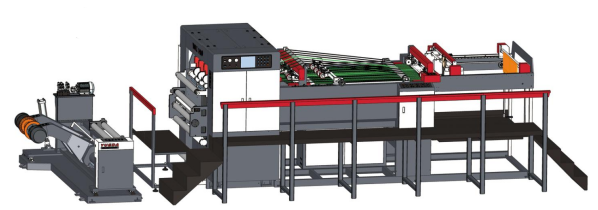
Step-by-Step Breakdown: Matching a Cutter to a Metalized Paper Line
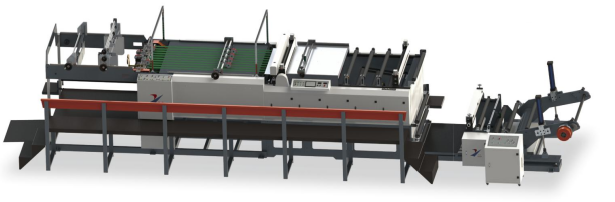
Buyers can work through the following sequence to decide between a double rotary cutter and a positioning sheeter.
- Define the finished sheet. Record cut length, sheet width and the tolerance the downstream printing or foiling process actually requires. ±0.1 mm is a machine capability; the required tolerance is a commercial decision.
- Decide whether the cut is register-critical. If the cut must follow printed artwork or an eye-mark, the positioning sheeter (YD series) is the starting point. If the priority is high-volume output at a fixed dimensional tolerance, the double rotary cutter (YDSLX/DWLX series) is the starting point.
- Match cutting speed to upstream output. Compare the cutter's sheet-per-minute capability with the laminating line's running speed. A DWLX cutter specified at 10–400 sheets per minute gives a wide operating band; a line that never approaches that range may not need a rotary architecture at all.
- Verify the accuracy specification, not the marketing adjective. Ask for the positioning accuracy figure (±0.1 mm on DWLX) and the correction method (dual photoelectric eyes, main and backup, for real-time position calibration).
- Confirm construction and control. Carbon steel construction supports the rigidity a rotary shear needs. Ask about the PLC control system, closed-loop servo tension control specified to 0.1 N precision, and thermal protection with automatic shutdown.
- Check working width and changeover. Confirm the width range the machine can serve (for example 800 mm to 1600 mm on YUEDA's multi-functional cross-cutting machines) and how quickly size changeover is achieved for the specification changes the plant actually runs.
- Confirm service terms before signing. Verify lead time, spare-part cost and response time, because these determine real cost of ownership once the machine is installed.
Use Cases: Where Each Cutting Architecture Fits
Cigarette and Tobacco Packaging
Tobacco packaging is one of the primary demand drivers for metalized paper, and it places a premium on dimensional consistency and surface quality. High-volume cigarette blank production typically favors the continuous output of a double rotary cutter, supported by laminating machines such as the gantry-type YDLM1300B that are built for cigarette and wine packaging.
Wine, Spirits and Premium Gift Packaging
Premium liquor and gift packaging often needs cuts that align with decorated panels and eye-marks. This is the classic positioning sheeter application, where photoelectric register correction matters more than raw sheets per minute.
Cosmetics and Premium Labeling
Cosmetic cartons and premium labels use metalized paper for its gloss and barrier properties. Mixed short runs with frequent specification changes reward machines with fast size changeover and a practical working-width range.
Comparison Table: Double Rotary vs. Positioning Sheeter
The table below summarizes the technical differences between the two cutting architectures as configured by YUEDA.
| Comparison point | Double rotary sheet cutter (YDSLX / DWLX series) | Positioning sheeter (YD series) |
|---|---|---|
| Cutting principle | Two rotating knives shear the web continuously; no stop-start cycle | Web is positioned against a register, then cut |
| Positioning accuracy | ±0.1 mm (DWLX series) | High-precision cutting of a range of packaging materials |
| Cutting speed | 10–400 sheets per minute (DWLX series) | Balanced for register precision rather than maximum throughput |
| Construction | Carbon steel frame for rigidity under rotary load | Machine frame with photoelectric positioning |
| Correction method | Dual photoelectric eyes (main and backup), real-time calibration | Photoelectric register detection |
| Best fit | High-volume output at a fixed dimensional tolerance | Cuts that must follow printed artwork or an eye-mark |
| Typical packaging use | Cigarette, tobacco and high-volume premium carton blanks | Wine, spirits, cosmetics and decorated gift packaging |
| Working width | Model dependent | Customizable 800–1600 mm on multi-functional cross-cutting machines |
Commercial Comparison: How YUEDA Lines Compare
Because the cutter is normally bought as part of a line, the commercial comparison matters as much as the technical one. YUEDA's comparison data sets out the position against European imported equipment and domestic local competitors.
| Comparison point | YUEDA | European imported equipment | Domestic local competitors |
|---|---|---|---|
| Purchase cost | Baseline | 40% higher | Similar initial cost |
| Delivery lead time | 30–45 days | 90+ days | Not specified |
| Maintenance model | 72-hour remote debugging; 24-hour after-sales | On-site fee service | 48-hour after-sales response |
| Annual maintenance cost | 20% lower than domestic alternatives | — | Baseline |
| Spare part cost | Baseline | 50% higher | — |
| Positioning precision | ±0.1 mm | Same working efficiency | ±0.3 mm |
| Service life | 8–10 years | — | 5–6 years |
| Annual failure rate | ≤1% | — | ≤3% |
| Material waste rate | 15% lower than domestic alternatives | — | Baseline |
| Energy consumption | Lower energy consumption at the same working efficiency | Same working efficiency | Same energy efficiency |
FAQ
What safety or compliance standard should a sheet cutter meet for European market access?
Industrial laminating machines must comply with EN ISO 12100:2010 for risk assessment and safety design in order to obtain CE marking for the European market. A cutting unit supplied as part of a metalized paper laminating line is evaluated under the same machine-safety framework, so buyers importing to the EU should require risk assessment documentation and safety design evidence alongside the cutter's accuracy specification rather than treating compliance as a separate purchase.
How accurate is a double rotary cutter compared with a positioning sheeter?
YUEDA's DWLX series double rotary knife cross-cutting machine is built to ±0.1 mm positioning accuracy, and YUEDA's comparison data places that figure against ±0.3 mm for domestic local competitors. Accuracy is maintained through control as much as construction: dual photoelectric eyes (main and backup) perform real-time position calibration, and closed-loop servo control manages web tension to a specified 0.1 N precision. A positioning sheeter addresses a different requirement — holding the cut relative to a printed register — so the two should be compared against the tolerance the application actually needs.
How do the two options compare on purchase cost and running cost?
On purchase cost, YUEDA equipment is positioned 40% below European imported equipment, while initial cost is similar to domestic local competitors. Running cost diverges more sharply: YUEDA's annual maintenance cost is 20% lower than domestic alternatives, and maintenance response is specified at 24 hours versus 48 hours for domestic competitors. Against European imports, maintenance is handled as on-site fee service, while YUEDA provides 72-hour remote debugging, and spare-part cost is 50% lower than European equipment.
What lead time applies, and how is delivery handled?
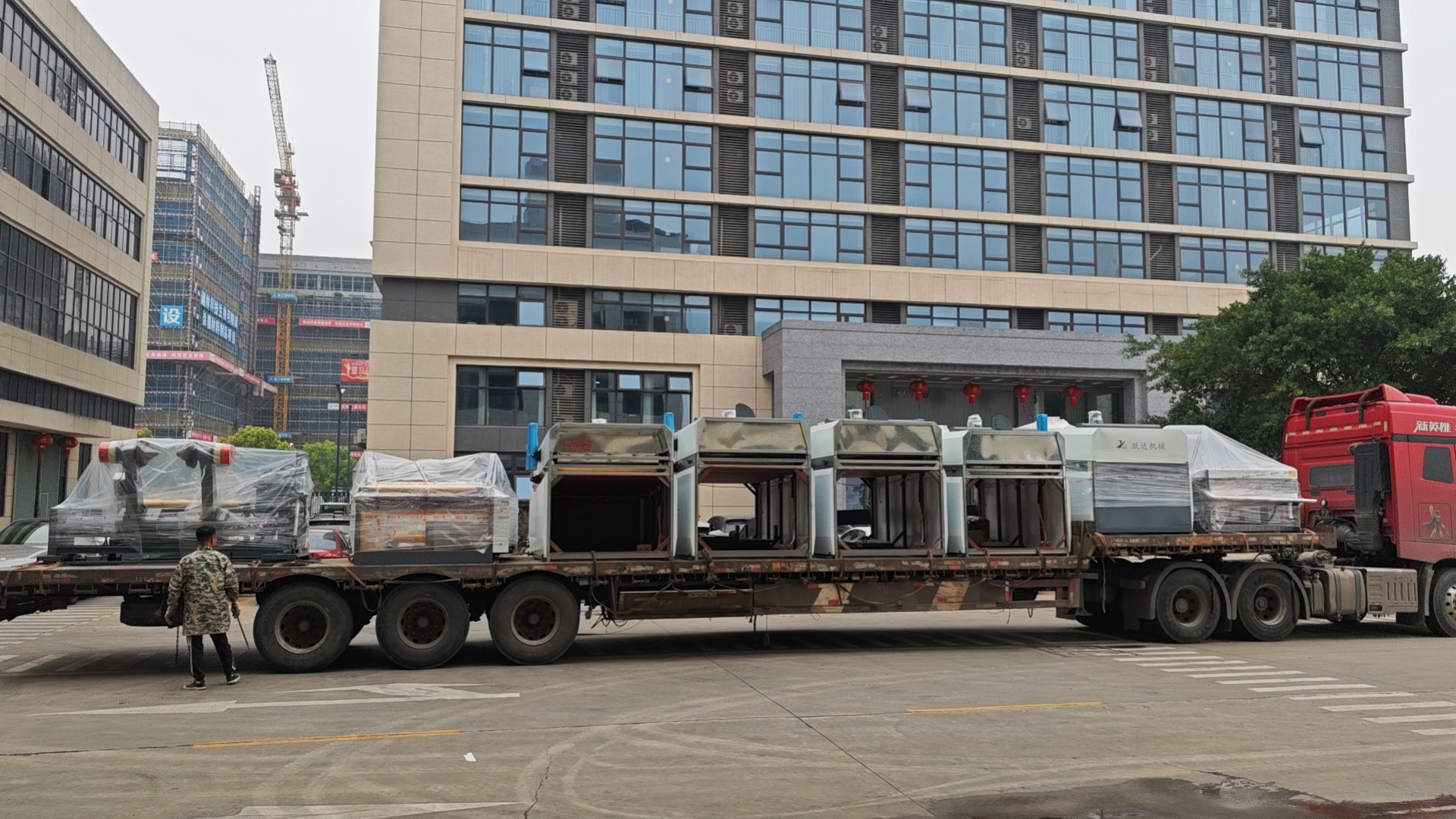
Delivery time for YUEDA equipment is 30–45 days, compared with 90+ days for European imported equipment — approximately 30% faster. YUEDA is located in Longgang, Wenzhou, in China's printing-city industrial cluster, and exports approximately 70% of its output to Southeast Asia, the Middle East, South America and Africa. Shipments are handled as factory-direct, heavy-duty packaging equipment loading for overseas industrial clients, using a professional loading team.
What should a buyer verify before committing to a full order?
Because speed, accuracy and tension control are interdependent, the practical validation step is to confirm the delivered specification and control architecture rather than a single headline number: the ±0.1 mm positioning accuracy of the DWLX series, its 10–400 sheets per minute cutting speed range, carbon steel frame construction, and the dual photoelectric correction and 0.1 N closed-loop tension control that sustain them. Buyers should also confirm after-sales response terms, spare-part pricing and lead time before signing. To move from specification to a delivered line, request a quotation and current machine specifications directly from YUEDA at www.yuedamachine.com.
Conclusion
Cutting accuracy and cutting speed are not separate specifications; they are two sides of one decision. A double rotary sheet cutter (YDSLX and DWLX series) earns its place when a metalized paper line needs high throughput at a fixed dimensional tolerance — 10 to 400 sheets per minute at ±0.1 mm on the DWLX series, held by a carbon steel frame, dual photoelectric correction and closed-loop servo tension control. A positioning sheeter (YD series) earns its place when the cut must follow a printed register or eye-mark and throughput is secondary to register precision.
Wenzhou Yueda Packaging Machinery Co., Ltd. (YUEDA) has manufactured gold and silver card production equipment since 1998, operates a 4,000 m² facility with a 25-engineer R&D team in Longgang, Wenzhou, and exports about 70% of its machinery. For buyers specifying a metalized paper laminating line, the practical next step is to define required sheet tolerance and throughput, then match the cutting architecture to those two numbers — not to a marketing label.
Next Step: Match a Cutter to Your Line
Download the YUEDA product catalogue with specifications for the DWLX double rotary cutter, YD positioning sheeter and YDLM1300B gantry laminating machine, or request a quotation and lead-time confirmation for your sheet size and throughput target.
Have Questions or Need More Details?
Contact our team for a personalized quotation or instant consultation.
Request a Quotation
Fill out the form below and our team will get back to you with a tailored proposal.
WhatsApp Direct Chat
Prefer to chat in real-time? Message us on WhatsApp for instant assistance & quick answers.
- Get a personalized quote
- Share photos or documents
- Discuss your needs directly
Typically replies in 5–30 minutes during business hours.