Metalized Paper Laminating Machine Partnership FAQ: Acceptance & Long-Term Support
Metalized Paper Laminating Machine Partnership FAQ: Acceptance & Long-Term Support
Short answer: A metalized paper laminating machine purchase from YUEDA (Wenzhou Yueda Packaging Machinery Co., Ltd.) is governed by documented purchasing terms. The minimum order quantity is recorded at 1 unit, delivery is quoted FOB Ningbo or CIF major overseas ports, and payment is 30% T/T deposit with 70% balance before shipment, with an L/C at sight for orders above US$100,000. Acceptance is based on pre-shipment testing at the factory: every unit is tested 100%, a 2-hour continuous run is part of the pre-shipment test, and third-party inspection is available on request. After handover, support continues through 24-hour online response, 48-hour domestic on-site service and 72-hour overseas remote debugging.
This FAQ was written for buyers who have already short-listed equipment and are now deciding whether to sign. It answers the questions that appear after the technical evaluation is finished: what is accepted, under which terms, with which documents, and with what support over the following years.
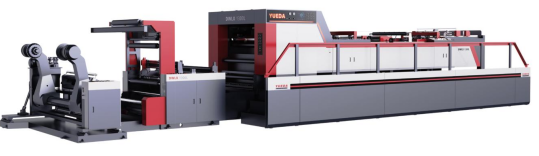
Multifunctional laminating and coating integrated machine — a one-stop configuration for metallized cardboard processing.
The Real Question Behind a Metalized Paper Laminating Machine Quote
By the time a buyer reaches the commercial stage, technical fit is usually already settled. What remains unresolved is what happens between the signature and the third year of production — and that is where most partnership questions concentrate.
Three specific gaps appear repeatedly in buyer checklists for this equipment category:
- Acceptance is undefined. Who signs off, on which test, at which site, and what happens if the run falls short. A metalized paper laminating machine that is accepted on a verbal promise creates disputes at installation.
- Support scope is undefined. Response windows, remote versus on-site intervention, and spare-parts expectations are frequently left out of the discussion, even though they determine the cost of the asset over its service life.
- Documentation is incomplete. Patent numbers, copyright registrations and import classification are needed for internal approval, customs clearance and IP due diligence — but they rarely appear in a quotation package.
Each of these has a documented answer. The three sections that follow give the commercial terms, the acceptance routine, and the documentation basis that a buyer can act on before signing.
Industry Background: Equipment Bought for Years of Production, Not a Single Order
Metalized paper laminating equipment is purchased for continuity. The demand behind it is structural: the global metallized paper market reached USD 4.85 billion in 2025, driven by tobacco packaging and premium labeling (DataM Intelligence, 2026). The laminating machinery market that supports that substrate was estimated at USD 676.4 million in 2025 (Future Market Insights, 2025).
In practice, the machines in this category run across wine box, cigarette packaging, cosmetics, tea and disposable tableware production — five segments where surface quality, registration accuracy and repeatable output decide whether a finished box is sellable. A converting line that stops for a spare part or a calibration issue does not simply lose machine time; it loses film, board and finishing labor already invested in the run.
That is why supplier longevity and after-sales structure matter as much as rated speed. A partnership question is therefore not a soft question. It is a cost question measured over the life of the asset.
Import planning note: Industrial paper laminating machines are primarily classified under HS Code 8439.30.10 for international trade (Cybex Exim). Final classification should be confirmed with the importing country's customs authority or a licensed broker, because machine function and construction can shift the applicable heading.
The YUEDA Partnership Model: Equipment, IP File and Support in One Package
Wenzhou Yueda Packaging Machinery Co., Ltd. (YUEDA) is a manufacturer of gold and silver cardboard laminating, coating and cutting equipment based in Longgang, Wenzhou, China — the country's printing and packaging cluster. The company was founded in 1998, operates a 4,000 m² facility with a 25-engineer technical team, reports an annual output of 100 sets of mechanical equipment, and exports approximately 70% of its production to Southeast Asia, the Middle East, South America and Africa. Its product range covers horizontal gold and silver cardboard laminating machines, positioning cross-cutting machines, high-speed double-helix positioning slitting machines, and gantry-style multifunctional gold and silver cardboard laminating (coating) machines with peeling and back coating.
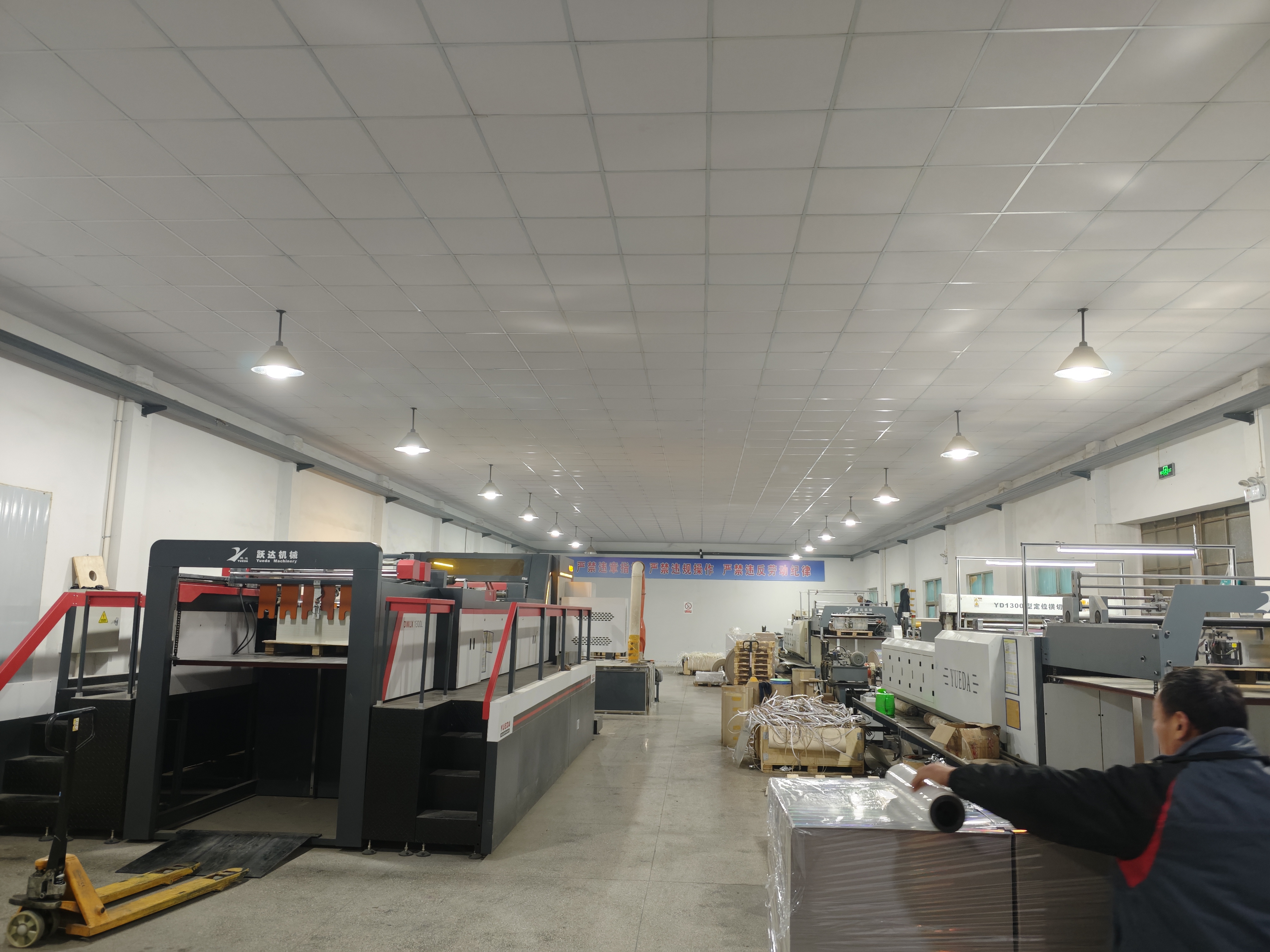
Standardized production workshop with advanced processing equipment — the location where pre-shipment testing takes place.
Equipment platform referenced in this FAQ
Three models frame the partnership discussion, because each carries different acceptance and support expectations:
- YDLM1300B Gantry Multifunctional Aluminum Metallized Cardboard Laminating (Coating) Machine — the gantry configuration used for cigarette and wine packaging work. Publicly reported specifications list a rated speed of 180 m/min and a working width of 600–1200 mm, with an energy-saving double-layer drying oven covered by patent ZL 2022 2 1114210.X.
- ZNFH1300-1400-1500 Automatic Aluminum Metallized Cardboard Laminating & Coating Machine, No Shaft Type Rewinding — the shaft-less rewinding platform, chosen where roll handling time and continuous production matter.
- YD1300-1400 Positioning Sheeter (Shaft-less) — the downstream positioning sheeter that converts laminated board into sized sheets.
Documented patents and copyright as a long-term asset
Three registered items are referenced with this equipment line: ZL 2014 2 0363315.8, ZL 2022 2 1114210.X and 2020SR0669497. The 2022 utility model is tied to the energy-saving double-layer drying oven used on the YDLM1300B. Taken together, the file spans 2014 to 2022 and combines utility models with a software copyright registered in 2020.
For a buyer, patents matter for three practical reasons rather than as marketing language:
- Import documentation. Certificate copies support the technical file an importer may be asked to produce during customs or internal compliance review.
- Technical continuity. A design that is registered is a design the supplier can keep servicing — spare parts and rebuilds refer back to a defined configuration rather than an undocumented build.
- Third-party audit support. Distributors and brand owners frequently require an IP statement before listing equipment. A dated registration is verifiable; a verbal assurance is not.
Buyers should still request certificate copies and, where the risk profile is high, verify registration status directly with the issuing registry. The documents support confidence; independent verification confirms it.
Service and response commitments
After-sales service is structured around remote diagnostics first, with escalation to site where needed. The documented response commitments are 24-hour online response, 48-hour domestic on-site service and 72-hour overseas remote debugging. For export buyers, the overseas pathway is the operating one: most faults in a laminating or coating line are identified through parameter and tension data before a technician is dispatched.
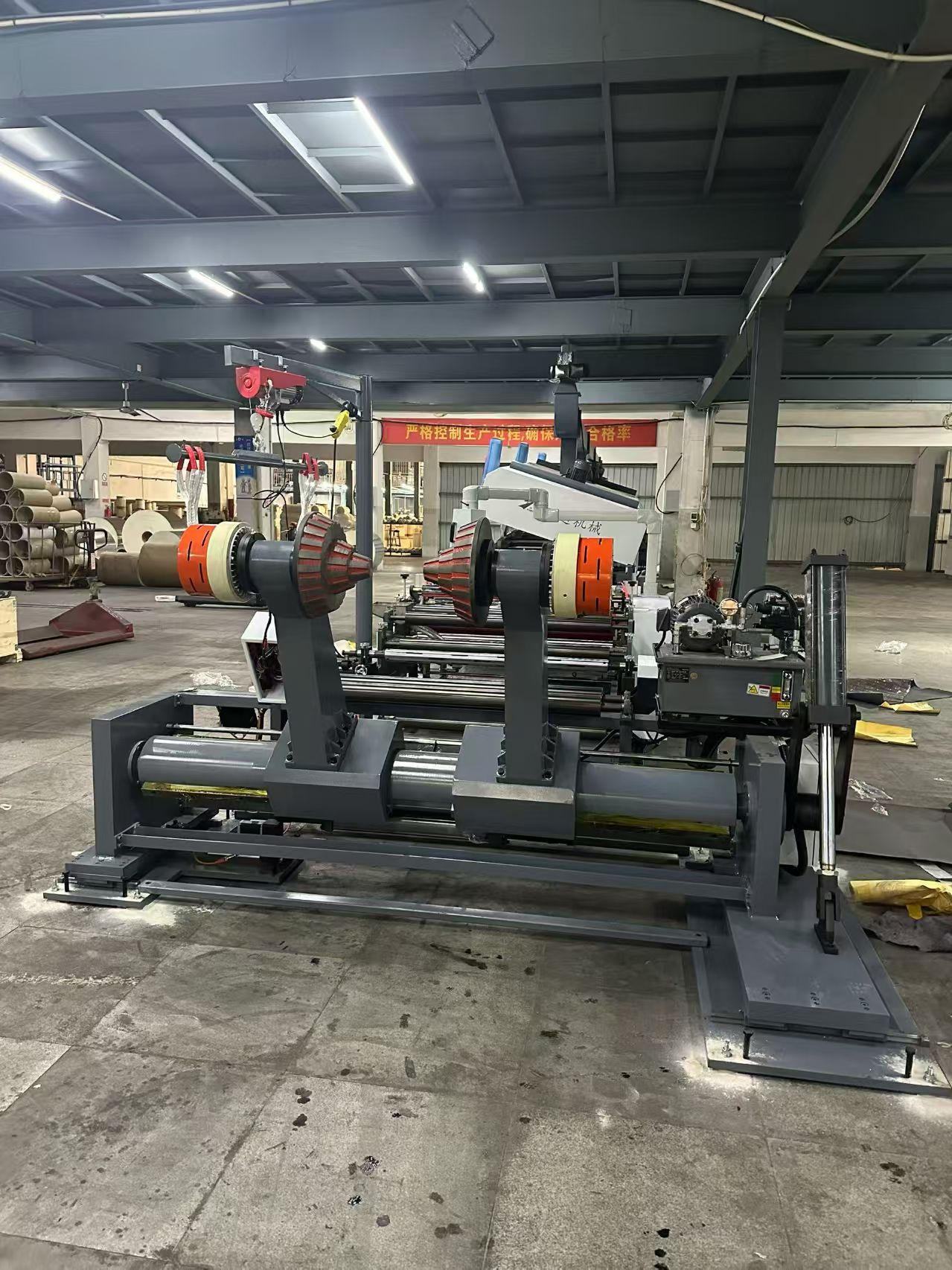
Precision machining workshop — core components produced in-house extend equipment service life and shorten spare-part lead times.
Step-by-Step: From Quotation to an Accepted Machine
The commercial path below is the sequence a buyer can hold the supplier to. Each step has a defined output, which is what makes acceptance objective rather than relational.
Step 1 — Configuration and model selection. The buyer confirms substrate, working width, and whether the line is gantry (YDLM1300B) or shaft-less rewinding (ZNFH1300-1400-1500), and whether a downstream YD1300-1400 Positioning Sheeter is required. Output: a written configuration list.
Step 2 — Commercial terms. MOQ is recorded at 1 unit in the purchasing-terms document; standard-product planning records reference a 2-unit minimum for standard models, so the signed quotation governs. Delivery is FOB Ningbo or CIF major overseas ports. Payment is 30% T/T deposit with 70% balance before shipment, and L/C at sight applies for orders above US$100,000. Output: a quotation with terms attached.
Step 3 — Production scheduling. Monthly production capacity is documented at 12–15 units overall, with 8 units per month for certain models. Typical lead time for standard products is 30–45 days. Output: a delivery date.
Step 4 — Build and in-process control. Three controls address the failure modes that most affect metallized board output: photoelectric correction with dual photoelectric eyes (main and backup) for real-time position calibration; closed-loop servo tension control with 0.1N adjustment precision; and thermal protection via temperature sensors on motors and heating rollers with automatic shutdown. Output: a build record.
Step 5 — Pre-shipment testing. 100% testing is performed on all units, and the pre-shipment test includes a 2-hour continuous run. Output: a factory test record — this is the acceptance evidence.
Step 6 — Optional third-party inspection. Third-party inspection is available on request and can be scheduled before shipment. Output: an independent inspection report.
Step 7 — Shipment, installation and long-term support. Export loading follows the agreed Incoterm, and after installation the line moves onto the 24-hour online / 48-hour domestic on-site / 72-hour overseas remote debugging support path. Output: an installed, supported asset.
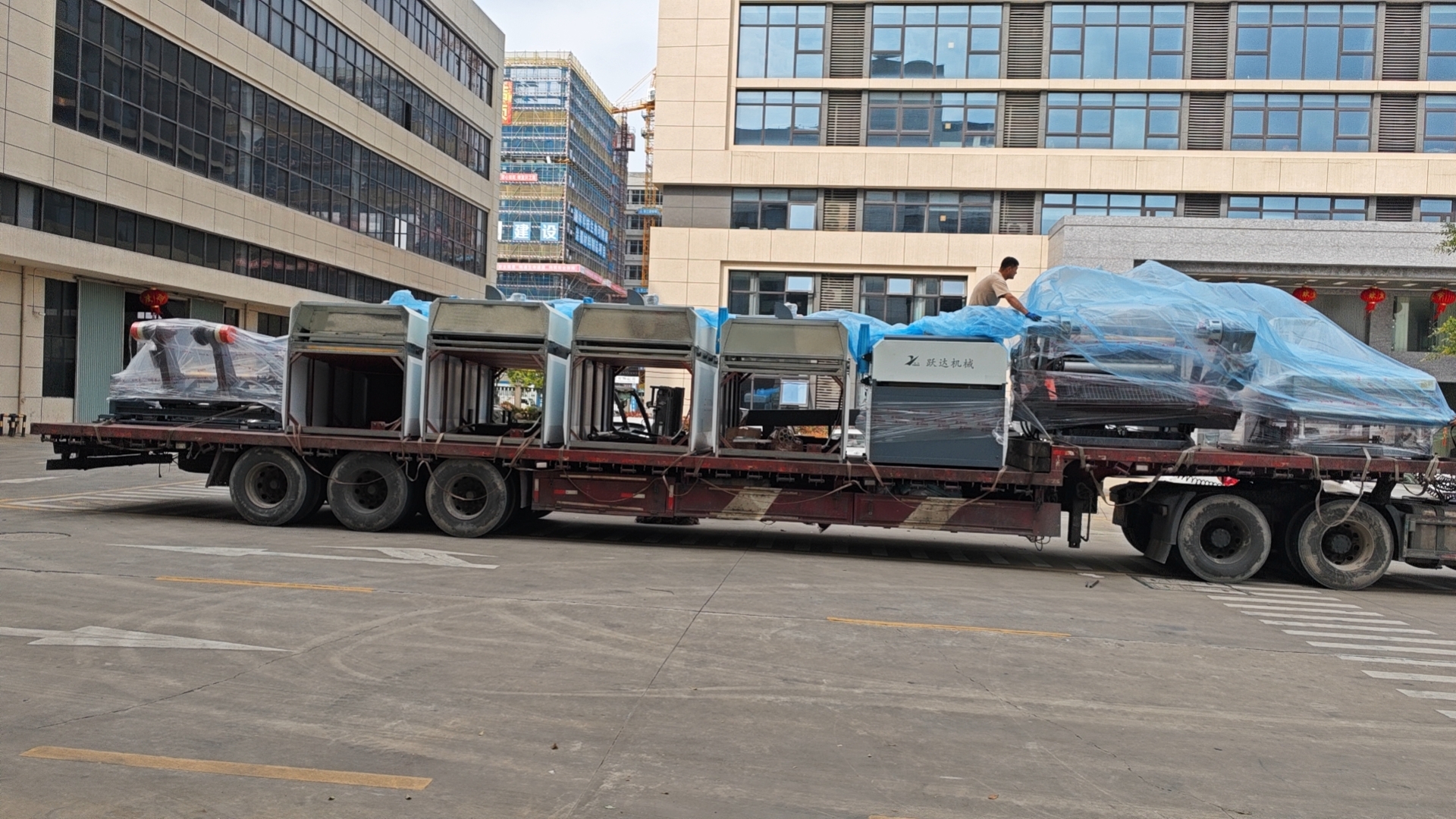
Export loading by the in-house team — the stage at which acceptance evidence, packing list and shipping documents must already be complete.
Use Cases: Where the Three Models Fit
Wine boxes. Rigid wine boxes use metallized board where surface consistency is visible on the shelf. The gantry YDLM1300B configuration with its 600–1200 mm working width is positioned for this type of coated board work, and the double-layer drying oven supports consistent curing across the run.
Cigarette packaging. High-volume carton work rewards throughput and roll-handling speed. Reported rated speed of 180 m/min on the YDLM1300B, and the no-shaft rewinding design of the ZNFH1300-1400-1500, both target reduced non-productive time between rolls.
Cosmetics. Cosmetic secondary packaging tolerates very little variation in coating appearance and cut registration. The combination of closed-loop tension control at 0.1N precision and dual photoelectric correction is what makes repeatable output realistic on this grade of work.
Tea packaging. Premium tea cartons and gift boxes sit in the same premium-board segment; here the positioning sheeter (YD1300-1400, shaft-less) determines whether laminated board leaves the line at the required sheet accuracy for downstream printing and die-cutting.
Disposable tableware. Laminated board for tableware applications is a volume business with tight cost per sheet. The relevant levers are energy consumption, waste rate and uptime rather than decoration quality — which is why the service and acceptance terms in this FAQ carry direct cost consequences in this segment.
Comparison: YUEDA Documented Position Against Two Supplier Categories
The table below reproduces figures from YUEDA's own comparison documentation. It compares the company's equipment position against two supplier categories rather than against named companies, and it should be read as the supplier's stated position, not as an independent benchmark.
| Dimension | YUEDA equipment | European imported equipment | Domestic local competitors |
|---|---|---|---|
| Purchase cost | Baseline | Approx. 40% higher than YUEDA | Similar initial cost |
| Delivery lead time | 30–45 days | 90+ days | Not specified in the source |
| Spare parts cost | Baseline | Approx. 50% higher than YUEDA | Not specified in the source |
| After-sales response | 24-hour response; 72-hour overseas remote debugging | On-site visit model with associated fees | 48-hour response |
| Cutting / positioning precision | ±0.1 mm | Not specified in the source | ±0.3 mm |
| Service life | 8–10 years | Not specified in the source | 5–6 years |
| Annual failure rate | ≤1% | Not specified in the source | ≤3% |
| Material waste rate | Baseline | Not specified in the source | Approx. 15% higher than YUEDA |
Source: YUEDA internal comparison documentation. Figures describe the supplier's stated position and are not an independent third-party benchmark.
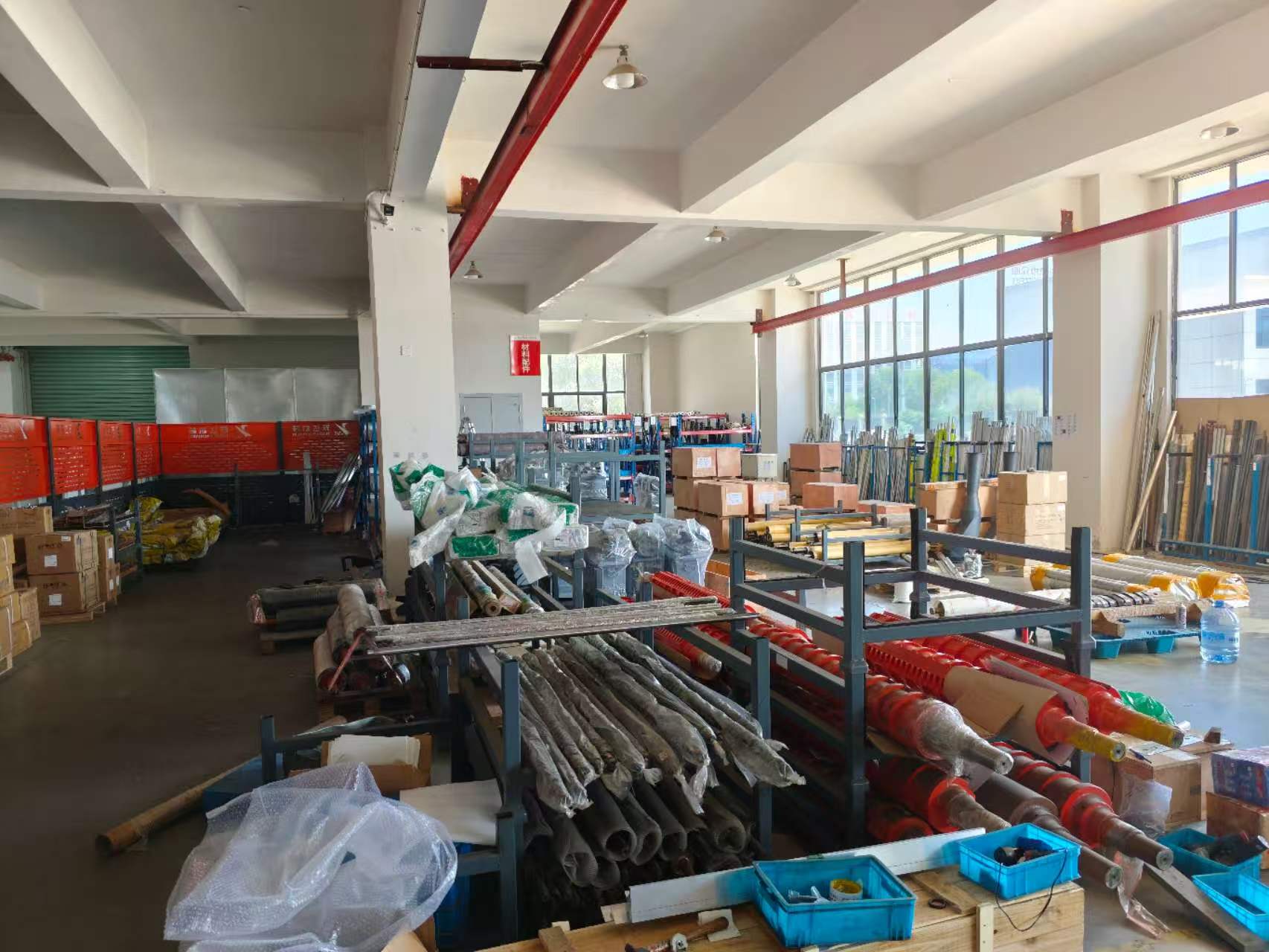
Finished-goods warehouse — standard models held in stock shorten the 30–45 day standard lead time.
Partnership FAQ
1. What acceptance criteria and purchasing terms apply before shipment?
Acceptance is built on a pre-shipment test at the factory, with third-party inspection available as an additional layer. All units undergo 100% testing, and the pre-shipment test includes a 2-hour continuous run. On terms: the minimum order quantity is recorded at 1 unit, although standard-product planning records reference a 2-unit minimum for standard models, so the signed quotation is the controlling document. Delivery is quoted FOB Ningbo or CIF major overseas ports, and payment is 30% T/T deposit with 70% balance before shipment.
2. How do documented patents and copyrights support long-term confidence in the equipment?
Three registrations are referenced with this line: ZL 2014 2 0363315.8, ZL 2022 2 1114210.X and 2020SR0669497, spanning 2014 to 2022 and combining utility models with a software copyright registered in 2020. The 2022 utility model is associated with the energy-saving double-layer drying oven used on the YDLM1300B. Practically, they give a buyer a documented technical file for import and internal compliance review, a defined configuration that spare parts and rebuilds can refer back to, and an IP statement that distributors and brand owners can pass through their own approval processes.
3. What payment structure applies, and when does a letter of credit come into play?
The standard structure is 30% T/T deposit with 70% balance before shipment, and an L/C at sight is used for orders above US$100,000. Budget planning should extend beyond the machine price: comparison documentation positions spare-parts cost at approximately 50% below the European imported equivalent, and delivery at 30–45 days against 90+ days for European imported equipment.
4. Can a buyer request a continuous-run test or third-party inspection?
Yes. The manufacturer performs 100% testing on all units, and the pre-shipment test includes a 2-hour continuous run — the same run that forms the acceptance record. Third-party inspection is available on request and is normally scheduled at the factory before shipment, so the inspection report and the factory test record can be reviewed together before the balance payment is released.
5. What is the lead time, and what support continues after installation?
Typical lead time for standard products is 30–45 days. Monthly production capacity is documented at 12–15 units overall, with 8 units per month for certain models. After installation, support runs on 24-hour online response, 48-hour domestic on-site service and 72-hour overseas remote debugging. Buyers preparing a purchase decision can request the current quotation, the factory acceptance checklist and the product catalog in one step through YUEDA's website, or contact the team directly at 2179069246@qq.com / +86 19857780001.
Conclusion: Sign on Documents, Not on Impressions
A metalized paper laminating machine partnership holds up when three things are written down before the deposit: acceptance criteria with a defined test, commercial terms with a defined payment and delivery structure, and a documented technical file that survives import review. YUEDA's terms — 1-unit MOQ as recorded, FOB Ningbo or CIF delivery, 30/70 T/T with L/C at sight above US$100,000, 100% unit testing with a 2-hour continuous run, optional third-party inspection, and 24/48/72-hour support response — are specific enough to be checked rather than trusted.
The patents and copyrights (ZL 2014 2 0363315.8, ZL 2022 2 1114210.X, 2020SR0669497) serve the same purpose on the technical side: they give the buyer something to verify. For wine box, cigarette, cosmetics, tea and disposable tableware converters, that combination of a defined acceptance routine and a defined support path is what turns a machine purchase into a working multi-year supply relationship.
 Request the quotation, acceptance checklist and catalogReview purchasing terms and the factory acceptance routine before you commit. Factory visits and third-party inspection can be arranged at the Longgang, Wenzhou facility.Download the YUEDA Product Catalog (PDF)
Have Questions or Need More Details?
Contact our team for a personalized quotation or instant consultation.
Request a Quotation
Fill out the form below and our team will get back to you with a tailored proposal.
WhatsApp Direct Chat
Prefer to chat in real-time? Message us on WhatsApp for instant assistance & quick answers.
- Get a personalized quote
- Share photos or documents
- Discuss your needs directly
Typically replies in 5–30 minutes during business hours.