
Synchronizing Shaftless Sheeting with Metalized Paper Laminating
Application guide for paper packaging projects: wine boxes, cigarette paper packaging, cosmetics, tea and disposable tableware.
A metalized paper laminating line does not run at the top speed printed on a nameplate. It runs at the speed of its slowest synchronized handoff, and on a sheet-fed line that handoff is almost always the point where cut sheets leave the cutter and enter the laminator. If the cutter delivers fewer sheets per minute than the laminator consumes, the gap turns into buffer stacks and idle drying capacity. If the cutter delivers a format the laminator cannot accept, the line stops for reasons that have nothing to do with either machine's performance.
This guide treats that handoff as an engineering calculation rather than a purchasing preference. It matches three YUEDA cutters — the YD1300-1400 shaftless positioning sheeter, the YDSLX1300-1400 double rotary cutter and the DWLX1300L-1400L positioning double rotary cutter — to the ZNFH1300-1400-1500 automatic aluminum metalized paper laminating and coating machine, and explains how the laminator's sheet roll width options from 600 mm to 1200 mm and its 5–150 m/min running speed translate into cutter choice, line balance and changeover planning.
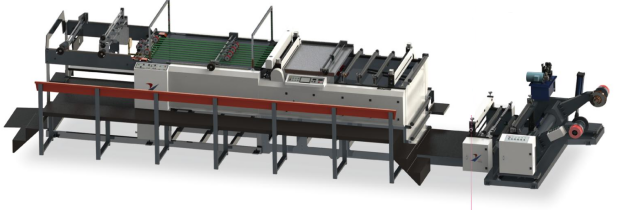
What synchronization actually means on a sheet-fed laminating line
On a cutting and laminating line, synchronization is the alignment of three separate interfaces, and a line can be synchronized on one and out of balance on another. The first is rate: sheets per minute leaving the cutter versus sheets per minute consumed at the laminator. The second is format: sheet length and sheet width must sit inside the documented range of both machines at the same time. The third is presentation: the stack must be square, clean and within the height and weight limits the next stage can handle.
The rate interface has a simple first-order rule that is often overlooked. One minute of laminating at a given speed consumes the same linear metres of sheet stock as one minute of sheeting at that same speed. In other words, a cutter rated at 95 m/min cannot support a laminator running at 150 m/min on a one-to-one basis, no matter how the sheet is cut. Expressed as a conversion:
Sheets per minute = line speed (m/min) × 1000 ÷ sheet length (mm)
This formula is the working link between the two halves of the line. It is arithmetic on nameplate values, not a measurement of delivered output, but it is accurate enough to eliminate line configurations that cannot work before a quotation is requested.
Where a cutting–laminating mismatch hides in the cost structure
A mismatch rarely appears as a single dramatic failure. It appears as a set of costs distributed across the shift. The most visible is work-in-process: a cutter running flat out in front of a slower laminator builds stacks that occupy floor space and require handling, and the rotary cutters are specified with a stacking height of 1500 mm and a stacking weight of 2000 kg, so that buffer is neither small nor easy to move manually.
The second cost sits inside the laminator. The ZNFH1300-1400-1500 is specified with a 12.5 m drying path. Dwell time in that path is the path length divided by the running speed, so at 150 m/min the sheet is in the drying section for about 5 seconds, while at 50 m/min it is there for about 15 seconds and at 5 m/min for about 150 seconds. A line that must slow the laminator down because the cutter cannot keep up is not merely producing less; it is running a different drying profile, which matters for coat weight and adhesion control. Those figures are calculated from the listed path length and speed, and should be treated as planning indications rather than process guarantees.
The third cost is rework caused by format drift. Both the YDSLX1300-1400 and DWLX1300L-1400L are specified with ±0.1 mm blank cutting accuracy, and the DWLX1300L-1400L adds ±0.1 mm longitudinal and transverse tracking accuracy. Where a cut sheet is out of square or out of tolerance, the error is carried into the laminating stage and only appears downstream at the die-cutting or folding step.
The fourth cost is the quiet one: jobs routed to the wrong machine because grammage limits were not checked. The ZNFH1300-1400-1500 is specified for paper from 40 g to 450 g. The two rotary cutters are specified with a cutter load of ≤550 gsm, and the YD1300-1400 sheeter carries a gram-weight for sheeting of 600 g. A board between 450 g and 550 gsm can therefore be cut but is outside the laminator's stated paper range, and a board between 550 g and 600 g sits outside the rotary cutters' stated load. Routing such a job without confirming it with the supplier is a planning error, not a machine fault.
Industry background: why the sheet-fed path still carries premium work
All five machines in this line family are listed for the same application cluster: printed wine boxes, cigarette paper packaging, cosmetics paper packaging, tea paper packaging, disposable waterproof paper tableware, cake paper packaging and chewing gum paper packaging. That cluster is defined by short-to-medium runs, frequent format changes and surface quality that shows every handling defect.
Demand for the substrate behind this work is documented separately from demand for the machines. DataM Intelligence, in a report dated April 2026, placed the global metallized paper market at USD 4.85 billion in 2025, attributing growth to tobacco packaging and premium labeling. That figure describes the paper market, not the laminating machinery market, and it should not be used as a forecast for any individual supplier's orders.
The practical point for a project team is narrower. Sheet-fed cutting followed by sheet-fed laminating remains the configuration of choice where an existing die-cutting, foil-stamping or window-patching department already runs on sheets, and where formats change often enough that re-threading a roll-fed line is the dominant downtime. The line-balance problem described in this guide is the price of that flexibility, and it is manageable with the right cutter.
Three cutter options and what each does to line balance
YD1300-1400 shaftless positioning sheeter
The YD1300-1400 is a shaft-less high-precision positioning sheeter. Its listed running speed is 95 m/min and 90 m/min across its variants, with a mechanical sheeting speed of 140 sheets per minute. Sheet roll width is 700–1200 mm or 700–1300 mm depending on the variant, maximum sheet roll diameter is 1600 mm, sheeting length runs from 400 mm to 1200 mm, sheeting accuracy is ±0.1 mm, stacking height is 1300 mm, and total power consumption is listed at 17.5 kW and 20 kW. Machine weight is 8000 kg and 8500 kg.
For line-balance purposes the shaftless design matters less than two numbers: 95 m/min and a 1200 mm maximum sheet length. The speed sets the first-order ceiling described above. The length limit sets a hard boundary — any job requiring a sheet longer than 1200 mm cannot run on this machine at all, regardless of speed.
YDSLX1300-1400 double rotary cutter
The YDSLX1300-1400 is a double cyclotron screw-knife high-precision cross-cutting machine with an up-and-down cutting action. Operating speed is ≤300 m/min with a cutting speed of 10–400 sheets per minute, material width 400–1400 mm or 400–1250 mm, cut length 450–1400 mm, blank cutting accuracy ±0.1 mm, stacking height 1500 mm, stacking weight 2000 kg, total power 73 kW and total weight 12,000 kg. Cutter load is ≤550 gsm, subject to density and quality considerations.
This machine removes the speed ceiling. At 300 m/min it can support a laminator running at the top of its 5–150 m/min range with substantial margin, and its 1400 mm cut length opens formats the sheeter cannot produce. The trade-off is scale: 73 kW of connected load and a footprint of roughly 9.6 m by 4.5–4.7 m.
DWLX1300L-1400L positioning double rotary cutter
The DWLX1300L-1400L carries the same double cyclotron screw-knife cutting action with a positioning function. Operating speed is ≤300 m/min, cutting speed 10–400 sheets per minute, material width 400–1400 mm or 400–1250 mm, cut length 450–1400 mm, stacking height 1500 mm and stacking weight 2000 kg. In addition to ±0.1 mm blank cutting accuracy it is listed with ±0.1 mm longitudinal and transverse tracking accuracy, and its dimensions are 13.85 m by 4.37–4.52 m with a listed weight of 17,000 kg and 15,800 kg across variants.
The additional tracking accuracy is the reason to choose this model over the YDSLX when printed register must be held through cutting — for example where a printed wine label or cosmetic panel is cut to a printed mark rather than to a fixed dimension. The extra 4 m of machine length compared with the YDSLX should be accounted for at layout stage.
The ZNFH1300-1400-1500 envelope: what the laminator will accept
The ZNFH1300-1400-1500 is an automatic aluminum metalized paper laminating and coating machine with no-shaft type rewinding. Its three frame sizes are listed with roller face widths of 1300 mm, 1400 mm and 1500 mm, matched to sheet roll width ranges of 600–1200 mm, 700–1300 mm and 700–1400 mm respectively. The 1300 frame therefore accepts sheets from 600 mm to 1200 mm wide — the range referenced in most project briefs for this machine family.
Running speed is 5–150 m/min, which is a wide band rather than a single operating point. Suitable paper is 40–450 g. Applicable aluminum foil thickness is 0.006–0.01 mm and film thickness 0.01–0.1 mm. Sheet roll diameter at the unwinding position is 100–1600 mm, foil roll diameter 600 mm, rewind diameter 100–1600 mm, with 3/6/12 inch sheet cores, 3 inch foil cores and 6/12 inch rewind cores. Drying path is 12.5 m and total power consumption is listed at 121 kW and 129 kW across the variants, on a machine approximately 21 m long, 2.9–3.2 m wide and 3.2 m high.
Two of these numbers drive everything else: the 5–150 m/min speed range and the width band. A cutter is only useful to this laminator if its sheet width falls inside the matching band and its output rate can reach the chosen operating point.

Balancing the line with arithmetic, not intuition
The following table converts laminator running speed into sheet demand at three common sheet lengths, and places the two cutter classes beside it for comparison. All figures are calculated from the listed nameplate values using the conversion above.
| Operating point | 700 mm sheets | 1000 mm sheets | 1200 mm sheets |
|---|---|---|---|
| ZNFH at 60 m/min (demand) | ≈86 sheets/min | ≈60 sheets/min | ≈50 sheets/min |
| ZNFH at 95 m/min (demand) | ≈136 sheets/min | ≈95 sheets/min | ≈79 sheets/min |
| ZNFH at 120 m/min (demand) | ≈171 sheets/min | ≈120 sheets/min | ≈100 sheets/min |
| ZNFH at 150 m/min (demand) | ≈214 sheets/min | ≈150 sheets/min | ≈125 sheets/min |
| YD1300-1400 supply at 95 m/min | ≈136 sheets/min | ≈95 sheets/min | ≈79 sheets/min |
| Rotary cutter supply at 300 m/min | ≈400 sheets/min (rate cap) | ≈300 sheets/min | ≈250 sheets/min |
Read the first column against the fifth row and the balance question answers itself. A single YD1300-1400 covers a ZNFH running at about 95 m/min and no more; against a 150 m/min operating point it supplies roughly 63% of demand. The shortfall percentage is the same at every sheet length, because both supply and demand scale with the same length conversion. What changes with sheet length is the absolute sheet count, and therefore how often stacks are changed and how much handling labour the line absorbs.
A worked example makes this concrete. A wine-box project plans to laminate 700 mm sheets at 120 m/min. Demand is about 171 sheets per minute. The YD1300-1400 at 95 m/min supplies about 136 sheets per minute, a shortfall of roughly 35 sheets per minute, or about 20%. The project team has three honest options: run the laminator at 95 m/min or below and accept the throughput, add a second sheeter, or specify a rotary cutter. Adding a YDSLX1300-1400 or DWLX1300L-1400L at 300 m/min covers the same demand several times over, but also adds 73 kW of connected load and about 9.6 m or 13.85 m of floor length.
There is a second ceiling that is easy to miss. The rotary cutters are listed with both a 300 m/min operating speed and a 400 sheets per minute cutting speed, and the two limits cross at a 750 mm sheet. Below that length the 400 sheets per minute cap binds and the web runs slower than 300 m/min; above it, the 300 m/min web speed binds. The YD1300-1400 has a similar crossing point: 95 m/min against 140 sheets per minute puts it at roughly 680 mm. Very short sheets therefore cost more rate than the headline speed suggests.
Step-by-step: specifying a synchronized cutting and laminating line
Step 1 — Fix the format envelope first. List every sheet length and width in the project, including the ones planned for next year. Compare against YD1300-1400 at 400–1200 mm length and 700–1200 mm or 700–1300 mm width, the rotary cutters at 450–1400 mm length and 400–1400 mm width, and the ZNFH at 600–1200 mm, 700–1300 mm or 700–1400 mm sheet width. Any job outside all three columns needs a different line concept, not a different quotation.
Step 2 — Set a realistic laminating speed. The 5–150 m/min band is a capability range. Choose the speed the project actually intends to run, since drying time, coat weight and adhesion behaviour all change across that band.
Step 3 — Convert that speed into sheet demand. Use the formula in this guide against the dominant sheet length. Where several lengths alternate, calculate demand at the shortest length in the mix, because that is the point of maximum sheet count.
Step 4 — Compare against cutter supply and decide the cutter class. If demand sits below roughly 95 m/min equivalent, the shaftless sheeter is sufficient. If the project needs higher rates or sheet lengths beyond 1200 mm, the rotary class is required, and the choice between YDSLX and DWLX1300L then turns on whether printed-register tracking is needed.
Step 5 — Check grammage routing before anything else. The laminating path stops at 450 g. The rotary cutters are listed to ≤550 gsm and the sheeter to 600 g. Any board outside the laminator's 40–450 g range has to be confirmed with the supplier rather than assumed.
Step 6 — Check utilities and floor. All three cutters require 0.8 MPa pneumatic pressure and AC 380 V 50 Hz supply. Nameplate power adds up to roughly 139–149 kW for a YD1300-1400 plus ZNFH combination, and roughly 194–202 kW for a rotary cutter plus ZNFH combination — arithmetic sums of listed figures, before air, conveying and lighting loads, and not measured demand. Footprint is a real constraint: the laminator alone is about 21 m long at 3.2 m high.
Step 7 — Plan the stack interface. The sheeter stacks to 1300 mm; the rotary cutters stack to 1500 mm and 2000 kg. Sheet roll diameter at the laminator's unwinding position is 100–1600 mm, with 3/6/12 inch cores. Confirm how sheets will travel from stack to unwind position, and how a 2000 kg stack will be moved.
Step 8 — Validate on material, not on paper. YUEDA's stated quality control is a 100% pre-shipment test with a 2-hour continuous run, and third-party inspection is available. Ask for the run to use your sheet length, width and grammage, and ask for the ±0.1 mm accuracy to be demonstrated on your material rather than on a demonstration board.
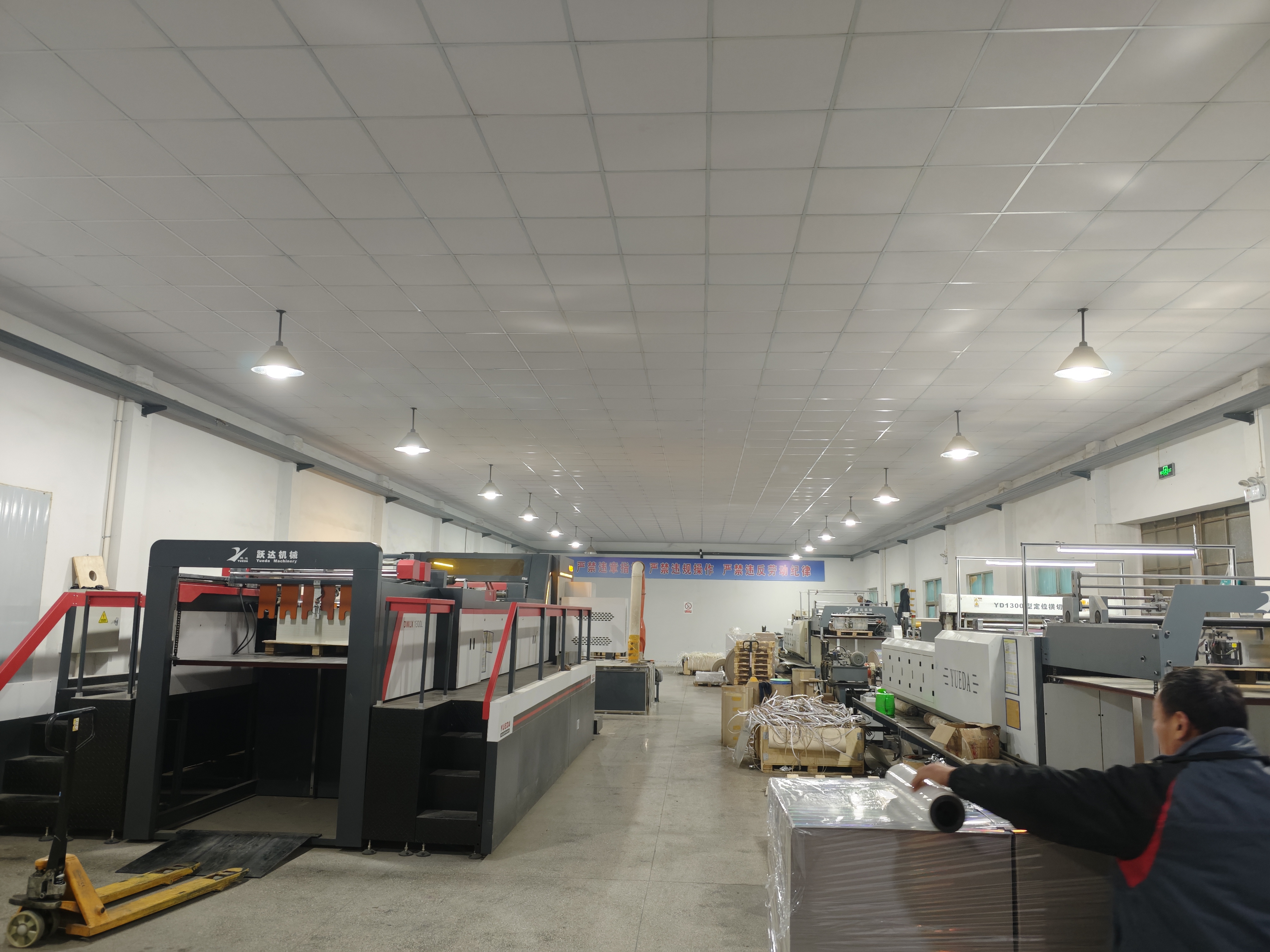
Application cases: matching the format to the package
Wine boxes. Heavy printed board, wide formats and a visible surface that shows every mark. This is where the 1400 mm cut length of the rotary class and the 700–1400 mm sheet width of the ZNFH1500 frame earn their place, and where ±0.1 mm accuracy is checked at the folding stage rather than at the cutter.
Cigarette paper packaging. A documented case from a cigarette packaging factory in Thailand describes two units running high-speed laminating for cigarette boxes over more than five years, with a reported 30% efficiency increase and 15% material waste reduction, and a requirement for humidity-resistant 24/7 continuous operation. That operating pattern — continuous running rather than frequent changeover — is the one that justifies paying for cutter headroom.
Cosmetics. A packaging factory in Vietnam reported ±0.1 mm cutting precision, zero rework rate and a 20% labour cost saving on one unit used for cosmetic packaging, with dust-proof design, fast size changeover and low maintenance cost cited as the highlights. Cosmetic work typically runs in a dust-free environment at controlled temperature, which is a room requirement as much as a machine requirement.
Tea and disposable tableware. Mid-weight stock, high sheet counts and price-sensitive conversion. Here the shaftless sheeter's balance against a laminator running in the lower part of its speed range is often the whole economic case, because a 95 m/min matched pair with no buffer waste can beat a faster unbalanced pair.
Changeover planning across formats
Changeover is where a theoretically balanced line loses its advantage. Three rules keep it under control.
First, group jobs by width before anything else. Moving between the 1200 mm, 1300 mm and 1400 mm width bands changes which machine combination is legal, not just which setting is used. A 1400 mm job needs the rotary cutter and the ZNFH1500 frame; a 1200 mm job can run on the shaftless sheeter and the ZNFH1300 frame.
Second, treat the 1200 mm and 1400 mm cut-length boundaries as hard gates. They define which jobs can run on which cutter, so a schedule that alternates a 1100 mm job and a 1350 mm job between the sheeter and the rotary machine will always carry an inter-machine transfer.
Third, change one variable at a time where the schedule allows. A change that alters width, grammage and sheet length simultaneously gives the operator three things to verify at once, and the ±0.1 mm accuracy claim is only meaningful if the first sheets off the new setting are actually measured. Changeover duration itself is not something this guide can state for your plant; record it on your own line for four to six weeks and plan from measured values.
Model comparison
| Model | Line role | Listed speed | Width / length | Accuracy | Notes |
|---|---|---|---|---|---|
| YD1300-1400 | Shaft-less positioning sheeter | 95 / 90 m/min; 140 sheets/min mechanical | 700–1200 / 700–1300 mm; 400–1200 mm | ±0.1 mm | Stack 1300 mm; 17.5 / 20 kW |
| YDSLX1300-1400 | Double rotary cutter | ≤300 m/min; 10–400 sheets/min | 400–1400 / 400–1250 mm; 450–1400 mm | ±0.1 mm blank | Stack 1500 mm / 2000 kg; ≤550 gsm; 73 kW |
| DWLX1300L-1400L | Positioning double rotary cutter | ≤300 m/min; 10–400 sheets/min | 400–1400 / 400–1250 mm; 450–1400 mm | ±0.1 mm blank; ±0.1 mm tracking | Stack 1500 mm; 17,000 / 15,800 kg |
| ZNFH1300-1400-1500 | Metalized paper laminating and coating | 5–150 m/min | 600–1200 / 700–1300 / 700–1400 mm | Paper 40–450 g | 12.5 m drying path; 121 / 129 kW |
| YDLM1300B | Gantry-type laminating and coating | 15–150 m/min working; 180 m/min machine | 600–1200 mm working width | Paper 100–350 g/m² | Energy-saving double-layer drying oven (Patent ZL 2022 2 1114210.X) |
The YDLM1300B is included because some projects arrive at this decision already committed to a gantry configuration. Its working range of 15–150 m/min and 600–1200 mm working width overlaps the ZNFH1300 frame closely, so the cutter side of the calculation does not change; what changes is the footprint and the 40 T installed weight.

Frequently asked questions
What utilities and floor conditions must be confirmed before the line is ordered?
All three cutters require 0.8 MPa pneumatic pressure and an AC 380 V 50 Hz supply. Nameplate totals sum to roughly 139–149 kW for a YD1300-1400 plus ZNFH combination and roughly 194–202 kW for a rotary cutter plus ZNFH combination, before auxiliary loads. Floor space is substantial: the ZNFH is about 21 m long, 2.9–3.2 m wide and 3.2 m high, the sheeter about 11.2 m long, the YDSLX about 9.6 m and the DWLX1300L about 13.85 m. Room conditions also matter for the application: documented projects for cosmetic packaging specify dust-free operation at controlled temperature, and cigarette packaging projects specify humidity-resistant, dust-proof, constant-temperature environments with 24/7 running.
Can the YD1300-1400 shaftless sheeter keep a ZNFH laminator at 150 m/min?
Not on nameplate arithmetic. The sheeter is listed at 95 m/min and the laminator at up to 150 m/min, so a one-to-one pairing supports roughly 63% of the laminator's top speed — about 136 sheets per minute at 700 mm against a demand of about 214. The same ratio applies at any sheet length, because both scale with length. To run above roughly 95 m/min, a project needs a rotary cutter, a second sheeter, or acceptance of the lower operating point.
What drives the capital and operating envelope of a synchronized line?
Four documented factors dominate. Connected power rises from roughly 139–149 kW with a shaftless sheeter to roughly 194–202 kW with a rotary cutter plus laminator. Floor length rises from about 11.2 m of cutter to about 9.6 m or 13.85 m, added to a 21 m laminator. Cutter count rises if one unit cannot cover demand. Width variant selection sets which frame of the ZNFH is required. Machine prices are configuration-dependent and are not published here; request a quotation against a defined format and grammage list rather than comparing headline machine prices across different width bands.
How is synchronization verified before shipment?
YUEDA's stated quality control is a 100% pre-shipment test consisting of a 2-hour continuous run, with third-party inspection available on request. For a synchronized line, ask for that run to use your own sheet length, sheet width and grammage, and ask for the ±0.1 mm cutting accuracy and, where applicable, the ±0.1 mm longitudinal and transverse tracking accuracy to be demonstrated on that material. Confirm the stack quality after the run as well as the dimensional accuracy, since stack presentation is what the laminating stage actually receives.
What is the lead time and the support path after delivery?
Lead time is stated as 30–45 days for standard models and 45–60 days for customized models, with a minimum order quantity of 1 unit. Customization covers voltage options of 110 V, 220 V and 380 V and control system selection. After-sales support is stated as 24-hour online response, 48-hour domestic on-site service and 72-hour overseas remote debugging. To move from a format list to a defined configuration, send your sheet length, width and grammage mix to YUEDA through Wenzhou Yueda Packaging Machinery Co., Ltd. and request a line-balance check against both the shaftless sheeter and the rotary cutter options.
Conclusion
The cutting and laminating halves of a metalized paper line are usually bought as one project and optimized as two. Synchronizing them is not a matter of matching brand names; it is a matter of matching three numbers. Sheet width must sit inside both the cutter's material width and the laminator's sheet roll width band. Sheet length must sit inside the cutter's cut range, which is 400–1200 mm on the YD1300-1400 and 450–1400 mm on the rotary cutters. Sheet rate must be calculated from the intended laminating speed, not assumed from the laminator's maximum.
Run that calculation early and the equipment decision usually resolves itself. A line targeting a laminating speed at or below roughly 95 m/min, with formats inside 1200 mm long and 1200 mm wide and board within 450 g, is well served by the shaftless sheeter paired with the ZNFH1300 frame. A line that needs higher rates, longer sheets, wider formats or printed-register tracking moves to the YDSLX1300-1400 or DWLX1300L-1400L and accepts the additional power and floor length. Either way, the number that matters is the one the buyer calculates before the order, not the one printed on the nameplate.
For the full technical specifications of YUEDA's laminating and sheet cutting equipment, download the company brochure: YUEDA product catalogue (PDF).
Have Questions or Need More Details?
Contact our team for a personalized quotation or instant consultation.
Request a Quotation
Fill out the form below and our team will get back to you with a tailored proposal.
WhatsApp Direct Chat
Prefer to chat in real-time? Message us on WhatsApp for instant assistance & quick answers.
- Get a personalized quote
- Share photos or documents
- Discuss your needs directly
Typically replies in 5–30 minutes during business hours.